Showing posts with label Korea. Show all posts

Bibimbap Recipe (Korea) - "Its So Healty !!!"

0 comments
  • i


Bibimbap is delicious, gorgeous on the plate, and easily tweaked for different palates and spice levels. I've included 6 vegetables in this recipe, but you can easily make it with just 3 or 4 or what you happen to have in your fridge. Koreans usually eat this rice dish with some beef, but I usually top mine with just an egg fried sunny side-up.

Ingredients:

  1. 2 cups medium-grain Korean (or Japanese) rice
  2. 1 large cucumber, sliced into thin strips
  3. 1.5 cups bean sprouts, parboiled and squeezed of excess water
  4. 1.5 cups spinach, parboiled and squeezed of excess water (3/4 lb before cooking)
  5. 2 carrots, julienned
  6. 4 shiitake mushrooms, rehydrated if dried and then sliced
  7. 1 zucchini, sliced into thin strips
  8. 1/2 lb meat (optional, both and cooked ground meat work well)
  9. Fried egg as a topping (optional)
  10. 2 Tbsp sesame oil
  11. Sesame seeds

How to Make:

  1. Cook rice in rice cooker or on the stove.

  2. Give cucumber strips a saltwater bath for 20 minutes and then drain.

  3. Season spinach with 2 tsp sesame oil, 1 tsp salt, and a dash of sesame seeds.

  4. Season bean sprouts with 2 tsp sesame oil, 1 tsp salt, and a dash of sesame seeds.

  5. Sauté carrots with a dash of salt.

  6. Sauté mushrooms with a dash of salt.

  7. Sauté zucchini with a dash of salt.

  8. Place cooked rice in large bowl and arrange vegetables on top.

  9. If desired, beef or egg can be placed in the center.

  10. Serve each with small bowls of red pepper paste (kochujang) and sesame oil.

  11. To eat, add a small amount of oil and desired amount of red pepper paste to your bowl and mix everything together with a spoon.


Source : Click Here
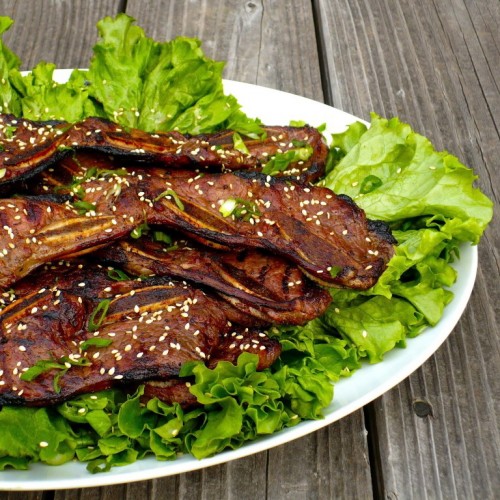
Kalbi Recipe (Korea) - "Korean Barbeque"

0 comments
  • i


Kalbi or galbi generally refers to a variety of gui or grilled dishes in Korean cuisine that is made with marinated beef (or pork) short ribs in a ganjang-based sauce (Korean soy sauce).[1] In the Korean language, galbi literally means "rib" and can often indicate uncooked ribs. In addition, the dish's full name is galbi gui, although "gui" (grilling) is commonly omitted to refer to it.

Galbi is generally made with beef ribs, and it may be called "sogalbi" (소갈비) or "soegalbi" (쇠갈비). Prefix "so" or "soe" (beef) is often omitted. It is also called bulgalbi when grilled over fire. As the literal meaning is "rib", the galbi dish can also be made with pork ribs or chicken. In such cases, the dish is called "dwaeji galbi" (돼지갈비) or "dak galbi" (닭갈비) to emphasize the main ingredient.
--(source)--

Ingredients:

  1. 5 pounds Korean style beef short ribs
  2. 1 cup brown sugar, packed
  3. 1 cup soy sauce
  4. 1/2 cup water
  5. 1/4 cup mirin (rice wine)
  6. 1 small onion, peeled and finely grated
  7. 1 small Asian pear, peeled and finely grated
  8. 4 tablespoons minced garlic
  9. 2 tablespoons dark sesame oil
  10. 1/4 teaspoon black pepper
  11. 2 green onions, thinly sliced (optional)

How to Make:

Sprinkle brown sugar over beef and mix well to evenly coat. Let sit at room temperature for 10 minutes while preparing marinade. In a bowl, whisk together remaining ingredients. Transfer beef into a large sealable freezer bag (you may need 2). Add marinade, press out excess air from bags, and seal. Turn bag over several times to ensure beef is evenly coated. Refrigerate for at least 4 hours but preferably overnight. 


Heat gas or charcoal grill to medium-hot. Drain excess marinade off beef. Grill short ribs, turning once, to desired doneness, about 3 to 4 minutes per side. Garnish with thinly sliced green onions, if desired. Serve whole pieces as a main course or cut into smaller pieces, using kitchen shears, for a starter or party nibble.


* NOTE: Korean-style short ribs can be found at most Asian markets. The cut, also known as "flanken," refers to a strip of beef cut across the bone from the chuck end of the short ribs. Unlike American and European-style short ribs, which include a thick slice of bone-in beef, Korean-style short ribs are cut lengthwise across the rib bones. The result is a thin strip of meat, about 8 to10 inches in length, lined on 1 side with 1/2-inch thick rib bones. The thin slices make for fast cooking on the grill.

A viewer, who may not be a professional cook, provided this recipe. The Food Network Kitchens chefs have not tested this recipe and therefore, we cannot make representation as to the results.


Source : Click Here

Kimchi Recipe (Korea) - "It is Korean Salad ??"

1 comments
  • i

This is a simple step by step guide for making Kimchi. This Type is known as Mat Kimchi, and is made using Chinese Cabbages. I plan to add some more kimchi recipes soon, so check back soon and please tell me about how you get on at the bottom of this page.
Hopefully you will be willing to give this a go at home and enjoy some real korean kimchi.

How to make kimchi, the ingredients used for this recipe are: 

Ingredients:


2 large Chinese Cabbages
230g rock salt
Water 

Ingredients Kimchi Sauce:


10 tablespoon of fish sauce
10 tablespoon of red pepper powder
1 onion
4-5 cloves of garlic
1 oriental pear
1 tablespoon of salt
1/2 tablespoon of sugar
small touch of ginger
4 spring onion

How to Make: 


Start by Cutting the Chinese Cabbages in to chunks, and then soak in plenty of water and add about 180g of salt. Leave this to soak for about 4-5 hours. I use a tray from my freezer as you can see from the picture. 


To create the sauce put all the ingredients in a blender except the spring onions, blend until quite fine, and slice the spring onions in to chunks and add to the mixture. 


Return the drained cabbage pieces to the tray and add the Kimchi sauce, mix by hand until it is all mixed together, Taste and it should be reasonably salty, add up to a further 50g of salt if required. 


Finally put the Kimchi in to some jars, leave in the fridge for a week, and it is ready to eat. The Kimchi will keep for at least 6-12 months probably longer.
Over time the flavour becomes more sour, if it becomes to sour to eat on its own use the Kimchi to make soups or stews as the soured Kimchi will add more flavour to these dishes. It is common in South Korea to make soups and stews with older Kimchi.
It can be eaten raw as a side-dish, or added to soups and other Korean dishes that are available on this site. 

Source : Click Here
Copyright 2011 Dapur Gudang.
Blogger Template by Noct. Free Download Blogger Template